
- For systems where non-farebox revenues represent a substantial portion of total operating and non-operating revenues, the risk tied to ridership performance is de-coupled from bond repayment.
- Structural protections can enhance bondholder security through revenue pledges that benefit from features such as direct transfers to the trustee or lockboxes, statutory liens, restrictive additional debt issuance tests, and cash flow cushions that provide downside protection should revenues decline.
- A narrower revenue pledge may carry greater exposure to consumer activity and transit system capital spending requirements. Significant capital requirements can pressure available cash flow.
Mass Transit Ridership: The Path to a 75% Recovery
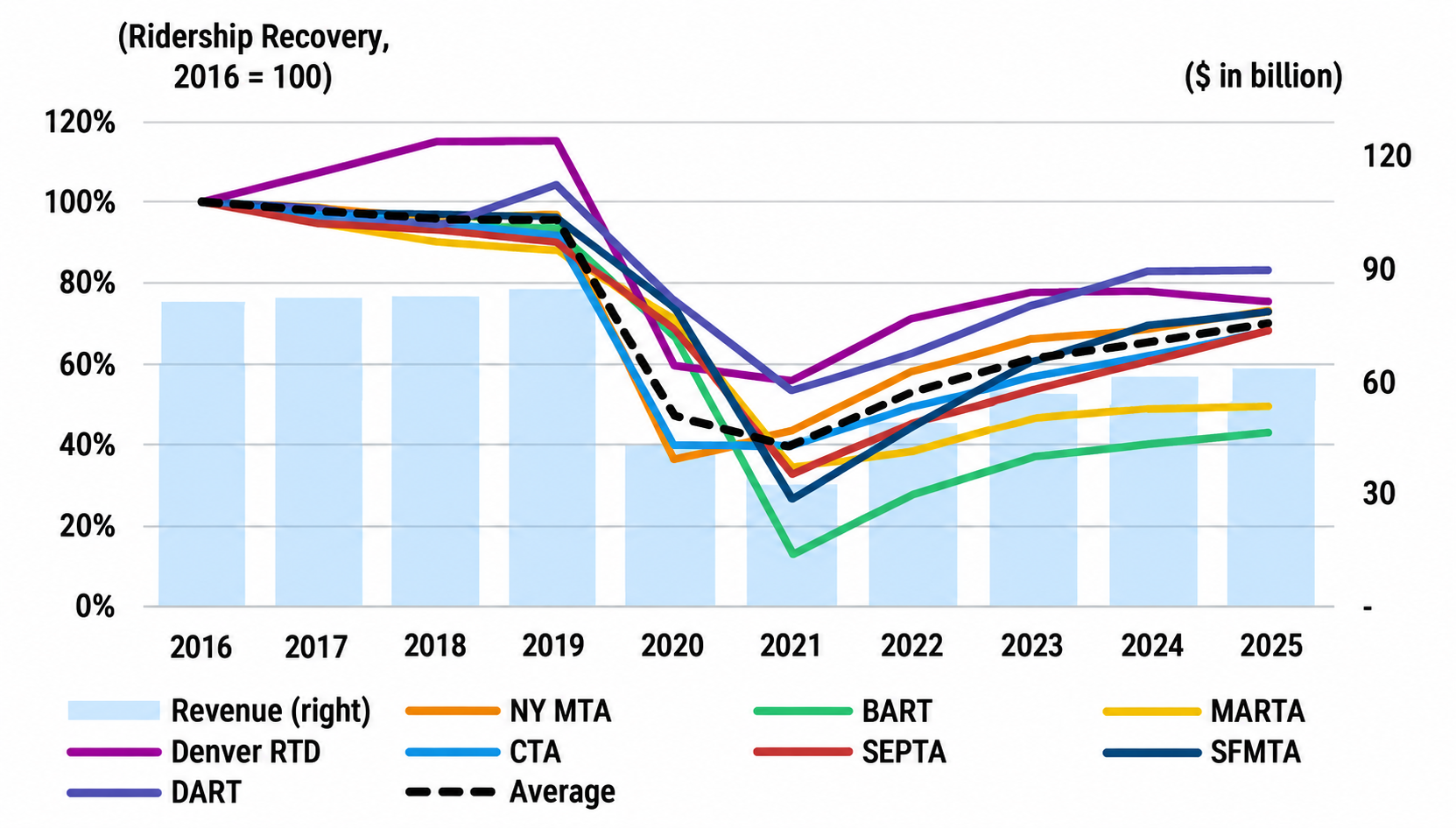
Transit systems across the country have not recovered the ridership lost to the COVID-19 pandemic. Fundamental changes in passenger behavior, such as remote work schedules and increased use of ride-share, have been some of the key drivers behind weaker ridership across the sector. Analyzing eight of the largest and most frequent municipal bond issuers as a proxy for the sector1, we note passenger volumes reaching about 75% of pre-pandemic levels in 2025. After declining almost 48% on average in 2020-2021, ridership seems to have stabilized in 2025, potentially setting a new baseline.
Exhibit 1: Mass Transit Ridership and Aggregate Farebox Revenue
Source: Ridership data from transit agency websites, as of FY2025.
Farebox Revenues Need All the Help They Can Get
Farebox revenues are typically not enough to cover operating expenses, debt service and capital expenditures, and that source has weakened with declining ridership. Farebox revenues can account for less than 20% of total revenues, leaving transit agencies increasingly reliant on other revenue sources to meet debt repayment and operating and maintenance (O&M) obligations.Exhibit 2: Transit Agency Revenue Profile
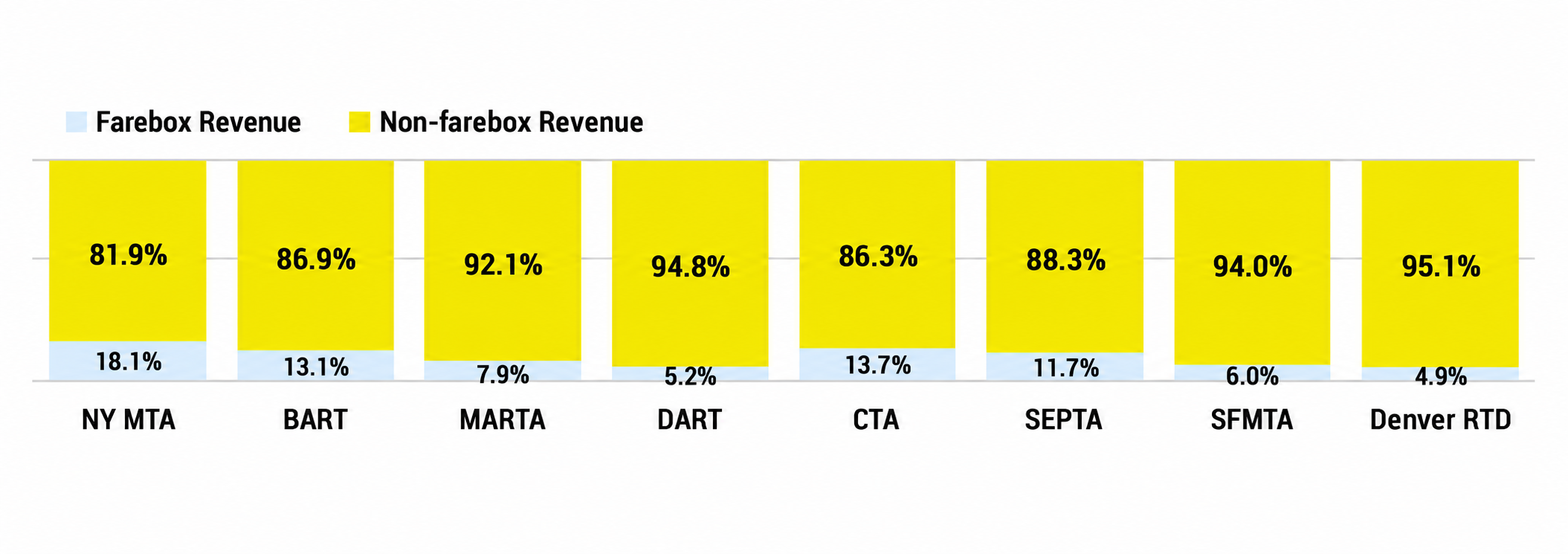
Source: Audited Comprehensive Financial Reports. As of FY2025.
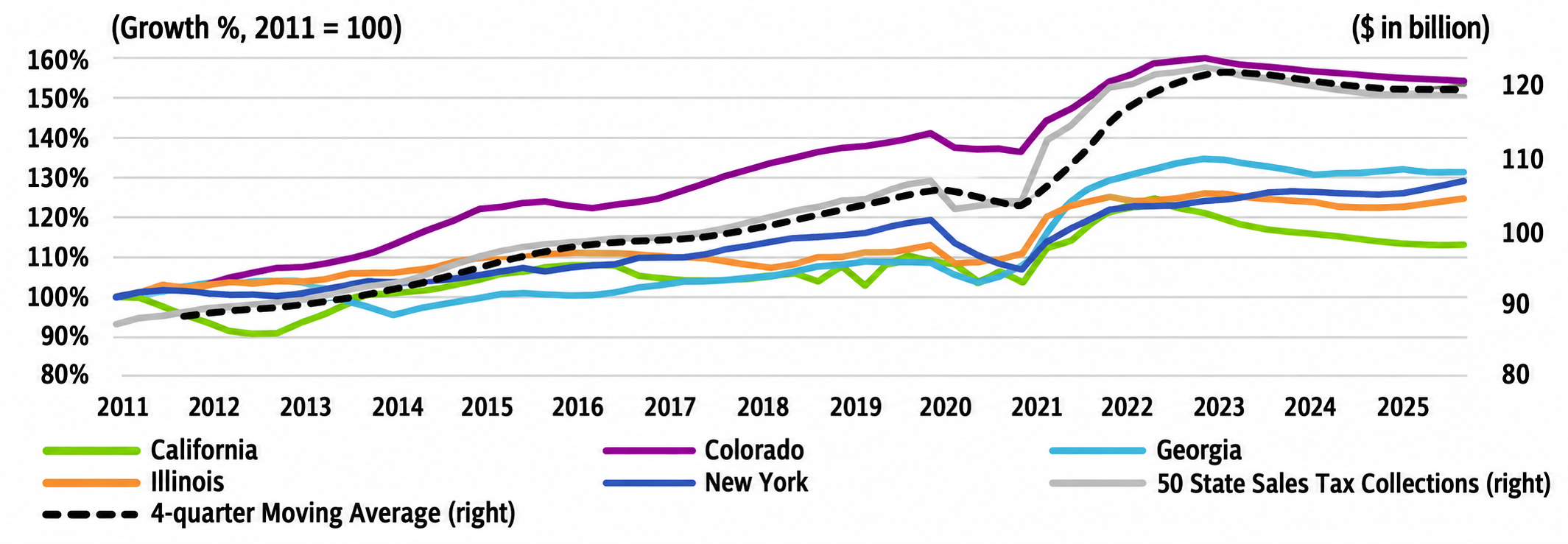
Sales taxes have become the primary revenue stream pledged to municipal bonds because they are part of a long-term funding solution for these systems. Although sales taxes are still exposed to consumer spending, which is influenced by prevailing economic cycles, transit issuers whose repayment of bonds is de-coupled from farebox revenues are more likely to meet debt repayment schedules because of increased financial flexibility. Non-farebox revenue (sales tax, payroll tax, motor vehicle tax, property tax as examples) can be stickier, less volatile, and therefore relatively more predictable for budgeting purposes. Sales tax collections across all 50 states have demonstrated resilience since the lifting of pandemic shutdowns.
Exhibit 3: State Sales Tax Collections
Source: Pew Research, as of December 2025.
Supportive Credit Features
Transit systems backed by a non-farebox dedicated revenue source fall higher on the credit rating spectrum, especially larger systems serving major metro areas. The dedicated tax revenue that supports these systems can provide a significant buffer between revenues and financial obligations. It is not uncommon to see pledged revenues exceed debt service requirements by 4.0x to 5.0x or more2. The maximum revenue decline to breakeven on debt service for any given year —amount dedicated revenue can drop and still support debt service —can range from 75% to 95% depending on the credit3. Furthermore, these systems usually include security features, like an additional bonds test (ABT) that require issuers to pass prior to taking on more debt. ABT levels can typically range from 135% to 300%4, meaning that revenues must exceed debt requirements by at least that much on a retrospective and go-forward basis (including new debt).Overcoming Complacency – Key Takeaways
The municipal landscape continues to evolve as new uncertainties are introduced, and existing stresses are magnified. Our research team maintains that through a rigorous analytical approach and credit selection, we are able to uncover nuances unique to certain credits and identify those that may be best suited to manage through economic, political, and social volatility.
1 NY MTA – New York Metropolitan Transportation Authority; BART – San Francisco Bay Area Rapid Transit District; MARTA – Metropolitan Atlanta Rapid Transit Authority; Denver RTD – Denver Regional Transportation District; CTA – Chicago Transit Authority; SEPTA – Southeastern Pennsylvania Transportation Authority; SFMTA – San Francisco Municipal Transportation Agency; and DART – Dallas Area Rapid Transit.
2 Debt service coverage metrics as of FY2025.
3 Maximum revenue decline is a PTAM calculated metric. The breakeven decline is the maximum decline for any given year.
4 ABTs from bond Official Statements.


Risks and Other Important Considerations
Not an Offer, Recommendation or Professional Advice: This document does not constitute advice or a recommendation or offer to sell or a solicitation to deal in any security or financial product. It is provided for information purposes only and on the understanding that the recipient has sufficient knowledge and experience to be able to understand and make their own evaluation of the proposals and services described herein, any risks associated therewith and any related legal, tax, accounting or other material considerations. To the extent that the reader has any questions regarding the applicability of any specific issue discussed above to their specific portfolio or situation, prospective investors are encouraged to contact PT Asset Management (PTAM) or consult with the professional advisor of their choosing.
Forward-Looking Statements: Certain information contained herein constitutes “forward-looking statements,” which can be identified by the use of forward-looking terminology such as “may,” “will,” “should,” “expect,” “anticipate,” “project,” “estimate,” “intend,” “continue,” or “believe,” or the negatives thereof or other variations thereon or comparable terminology. Due to various risks and uncertainties, actual events, results or actual performance may differ materially from those reflected or contemplated in such forward-looking statements. Nothing contained herein may be relied upon as a guarantee, promise, assurance or a representation as to the future.
Investing involves risks; principal loss is possible. There is no guarantee that the strategies and services will be successful or outperform other strategies and services. Certain assumptions may have been made in connection with the analysis presented herein, and changes to the assumptions may have a material impact on the analysis or results. The information contained herein has been obtained from sources considered to be reliable, and is subject to change without notice. PT Asset Management, LLC does not guarantee its accuracy, adequacy or completeness and is not responsible for any errors or omissions for the results obtained from the use of such information.
CFA® and Chartered Financial Analyst® are registered trademarks owned by CFA Institute.
PT Asset Management (PTAM) is the advisor to the Performance Trust Funds. Distributed by ALPS Distributors, Inc. © 2026 PT Asset Management, LLC. All Rights Reserved. Investment and Insurance Products: Are not FDIC or any other Government Agency Insured • Are not Bank Guaranteed • May Lose Value.